


One of the things I loved the most about researching the Empress of Ireland shipwreck, was the many different directions it took me in. One of these pieces of string led me to the British Home Children, a Canadian scandal of epic proportions.

Between 1869 and 1948, Britain shipped more than 100,000 boys and girls, some as young as four, to work on Canadian farms and as household servants. These kids were either orphans or from poverty-stricken families, and the thought was that they’d be better off in countries like Canada, Australia and South Africa.
Nine hundred and eighteen of these children came to Canada on the Empress of Ireland. Many of these kids, whose average age was ten for girls and twelve for boys, were used as cheap farm labour. The girls were put to work in houses and in the fields. There was little or no supervision, and many were subjected to horrible neglect and abuse.
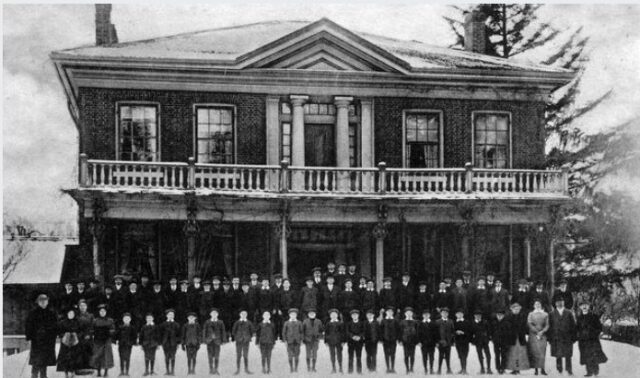
Around 10,000 British Home Children enlisted in the Canadian Expeditionary Force during the First World War. For many it was the only way they could return to England and a way out of abusive situations. Unfortunately, more than a thousand died.
On May 28, 1914, George Bogue Smart, the chief inspector of British immigrant children, was travelling in first class on the Empress of Ireland. Eleven British Home Children had been on the incoming voyage of the Empress the week before and he was on his way to England to bring back another group of children to work in Canada.
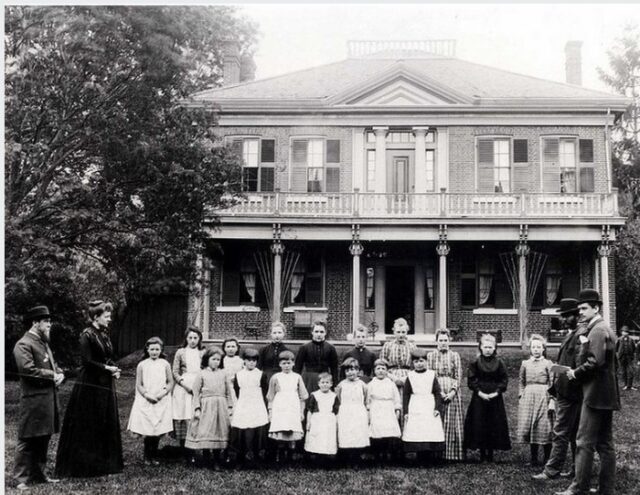
When the Empress of Ireland collided with the Storstad in deep fog, Bogue Smart was one of the few passengers to survive the sinking. To give Bogue Smart some credit, under his watch, immigration of unaccompanied children under 14 stopped, and importing child labour was banned altogether by 1928. Although small numbers of children continued to be sent to Canada until after the second world war.
The UK and Australia have apologized to the descendants of the British Home Children for this forced migration. The Canadian government has not. Instead, we declared that 2010 was the Year of the British Home Child and Canada Post released a stamp.

It’s estimated that between 10 to 12 percent of our population is made up of the descendants of British home children. Are you one of them? I’d love to hear your story.
Related:
© All rights reserved. Unless otherwise indicated, all blog content copyright Eve Lazarus.


What a pathetic story. What would have happened to the children if they had remained in England? It’s fascinating that there were so many children and now there are so few. No one has 8 to 14 children each anymore. They barely have one! (as in my case but that was due to circumstances beyond my control) I did hear of one story but the details were so dim I have no details; the 2nd husband of one of my paternal aunts (now both dead) said his parents came from Dr. Barnardo’s home, but he had no other information. He was in his 60s when I spoke to him, and he couldn’t remember anything other than that, so I was always sad he had nothing written down, and no dates etc. He said he had been told that information. Thanks for this post. I love the Canadian stamp.
It was a different era and one with vastly different ethnics from today. The treatment of these children has similarities with Canada’s indigenous residential schools which were in turn modelled on the British private schools. Children were to be seen and not heard.
I had no knowledge of this until now….and yes the treatment similar to Canada’s Indiginious…… But some how never brought to light!
My stepmother’s father was one of these children. The story I heard was that he lied about his age at 15 and enlisted in WWI. He was gassed by nerve gas and discharged and I think received compensation for that but I’m not sure. He abandoned his wife and 3 children in the 1930’s and returned to England where he then had another family. My stepmother never saw him again. She was 8 and the oldest of the 3.
The church I grew up attending, in the Eastern Townships of Quebec, included one quiet older gentleman who had been one of the home children. Supposedly the family he was assigned to treated him reasonably well, but he always seemed quite withdrawn, had few social skills, never seemed very happy and wasn’t included in many events – what sad stories!
You have not blown the story out of proportion and it is indeed part of Canada’s history with many family’s decendanting from immigrant teenagers and children. Hardship fell upon families from lack of work, not enough money to feed the family, illness and the two great wars that not only took the lives of soldiers and left many without limbs to return to previous work but also many came back with shell shock and unable to function. Finding themselves either a widow or with a husband unable to provide enough food for the family there were many mothers who did contact an agency who advertised they would keep the child (children in some cases) from starving at least and offered training for boys either in the fields growing food, caring for the livestock or on the ships. And then there were the children with fathers who found themselves with a very sick wife or deceased wife and could not care for the children by themselves. Many of the children were much loved. The parents who signed their children over to agencies (for the good of the child) no longer had a say and many of the children were sent by the agency -and – the Canadian immigration jointly to work in Canada. Canada’s office was based in London. Some children were sent via the Roman Catholic Church who received the children in much the same manner ie family lacking food or a spouse and I believe in Scotland some were from the streets sent to Quarriers and other agencies one can research.
Placement for the child/young teen was “selected ” from applications received from farmers or family’s wishing for household help. The Canadian agent did visit the child and there are progress reports filed however there were times a child was afraid to report abuse or afraid they would not get another placement and be sent back to England and possibly face hunger again… The abuse suffered included lack of warm clothes in winter, made to work long hours doing mens work, beaten, long hours cooking and cleaning for entertaining, sexual harassment, dismissal due to pregnancy, and many more that “should not have happened”.
Although many suffered greatly at the hands of abusive placement… not something Canadians should be proud of most of the men fought in the great wars for Canada. It is true that some ran away from their placements and were returned to England but not many. It is also true that most of the immigrants worked hard and the contract included them attending school and church however most did not attend either. They were paid per the contract and $ was to be deposited in (the Bank of Montreal) on behalf of the child with a small allowance given for them to buy something or attend a movie, etc.
The child was Endentured via contract through an government agency from ages 3 to 18. Not a typo.. from age 3 they could be sent. Indeed all part of our history and should be known.
Thanks so much for taking the time to add to the story.
There is a lot of truth to this. Thousands of children from England were shipped to Canada starting around 1915. They were called boat children. My father Stanley Harcourt Staples, was born in London England in 1910. His mother brought my dad who was four years old at the time, along with his little brother, Vernon Benjamin Staples and placed them in an orphanage in Edmonton, Alberta. Dad was adopted by an American family ( The Harding’s) and was raised in the United States. I have no idea what happened to his brother. Dad was the father of nine, grandfather to 27 at the time of his death in 1994. The family has grown to over 100, so there could possibly be a great population of English heritage in Canada.
I watched a CBC movie about this in the 80s with RH Thomson and Cedric Smith. Very moving and a bit scary as a pre-teen.