


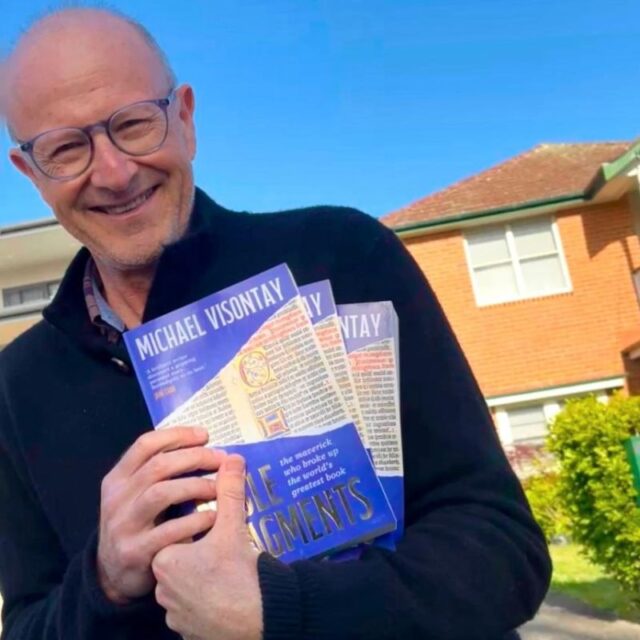
I had the pleasure of meeting up with fellow Aussie and journalist Michael Visontay last week. Michael was here to write a travel story for the Sydney Morning Herald but he was also here to visit Special Collections at the Vancouver Public Library and see one of their prized collections—a leaf from the Gutenberg Bible.
Gabriel Wells
In 1921, Gabriel Wells bought a Gutenberg Bible that was missing 50 of the original 640 leaves (each leaf has two pages). He paid US$13,000 – around $233,000* in today’s US dollars – a bargain at the time.
Wells, a New York-based rare book dealer, thought he could make more money by taking the Bible apart and selling it off in pieces. He called these Noble Fragments. Each one went into a leather portfolio and was accompanied by an essay written by his friend Alfred Edward Newton.
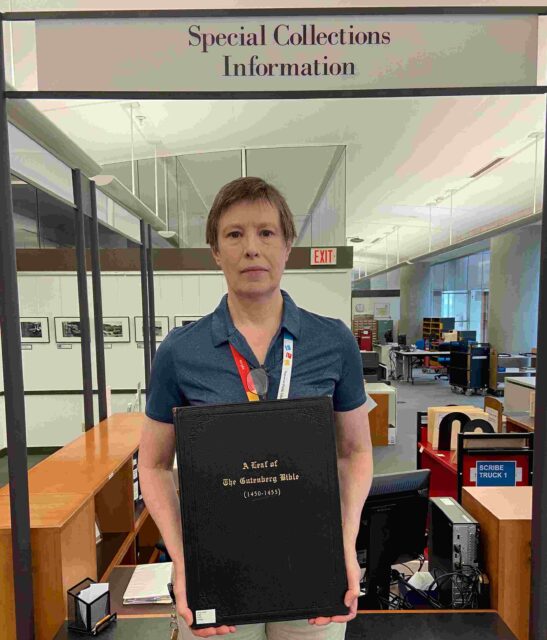
I first heard about the Gutenberg Bible’s Vancouver connection through Janet Thornton. Janet’s a library tech who gave my SFU writing students a tour of Special Collections a few years back. Janet connected me with Michael. The Carnegie Library (Main and Hastings) she says, purchased the leaf for $150 in the early 1920s.
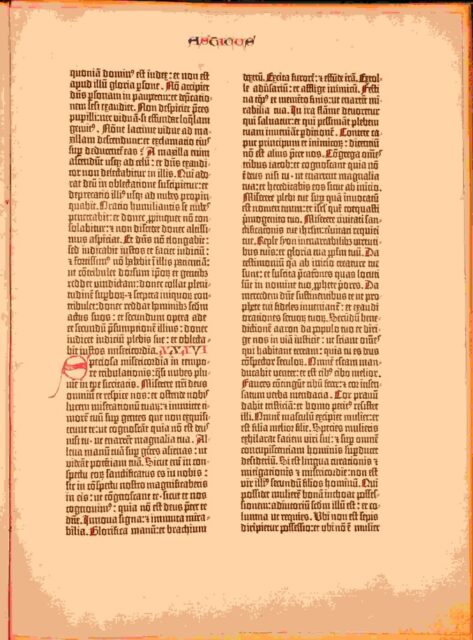
Noble Fragment
“Our leaf contains Ecclesiasticus, chapters 35-38. The page starts at 35:16 and ends with 38:5 on the verso. It has been bound and preceded by a bibliographical essay by A. Edward Newton,” says Janet. “The bound volume is kept in a slipcase. It does not go on display, as continuous light would be harmful to it. However, anyone can view it – no appointment necessary.”
Only 180 copies of the Bible were published and 48 copies are known to have survived intact. Michael says the last one sold in 1987.
“If one sold today it would be insured for US$55 million. But scholars say it is so rare that buyer interest would likely drive the price up to around $100 million,” says Michael. “The Gutenberg Bible is the Holy Grail of rare books. It was the first book published on a printing press in Western Europe in the mid 1400s and that was the gateway to the democratization of knowledge. Now people could have their own book published, they didn’t have to wait for the church.”
Later, it was the rare book that the wealthy wanted to buy to signify that they had refinement, culture and wealth, he says.
Michael Visontay’s connection
Michael has written a book called Noble Fragments: The Gripping Story of the Antiquarian Bookseller Who Broke Up a Gutenberg Bible which tells the story of his own family’s connection to the book.
Shortly after his mother died at the start of the Covid lockdown, Michael was going through a box full of family documents and came across a reference to Gabriel Wells and the Gutenberg Bible.
“I’d been a journalist for 35 years, and because of Covid, I had a lot of time on my hands. I wanted to find out as much as I could about this man because thought I knew everything about my family’s past.”
When Wells died in 1946 he left some of his fortune to family members in Hungary who had survived the Holocaust.
Michael’s grandmother was murdered at Auschwitz, but his grandfather and father survived and returned to Hungary to run the family’s delicatessen. They rented a room from Wells’s niece, who had lost her husband to the Holocaust and was renting rooms to make ends meet. She married Michael’s grandfather, and they used some of her inheritance to immigrate to Australia.
*https://www.in2013dollars.com/us/inflation/1921?amount=13000
© All rights reserved. Unless otherwise indicated, all blog content copyright Eve Lazarus.


This is your best article yet; it gave me the shivers.
The things I don’t know. Thanks so much for writing this.
I’ll have to hurry down to the library collections to see it! How thrilling.
Did you change the look of your blog? It looks very nice, but mysteriously I miss the “old brick” background.
(unless that’s on another blog)
Thanks so much Loretta, glad you liked the blog and Special Collections will love your visit!
I have changed my blog – it’s been given a complete rehaul by the wonderful Jen Gfeller – thanks for noticing! (The bricks may come back in a different form at a later date…)