


I was biking around Stanley Park with my daughter Megan last week and we stopped at Prospect Point to read the plaque about the SS Beaver.
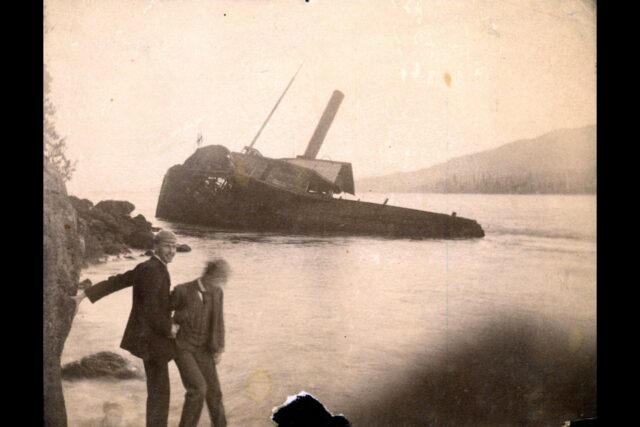
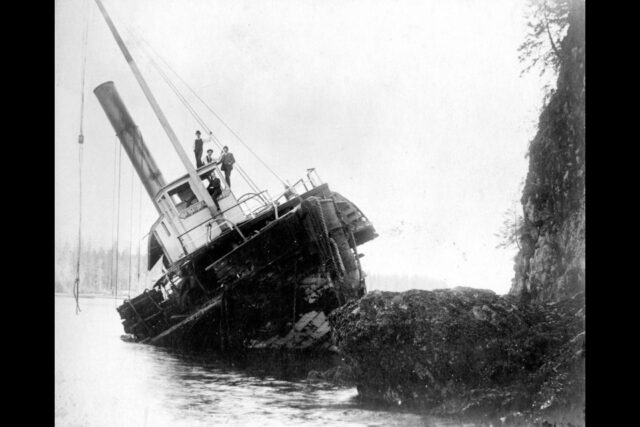
The Beaver ran aground here on July 26, 1888, and depending on what and where you read it, the wreck was caused either by strong winds, foggy conditions, a sloshed crew, or perhaps all three.
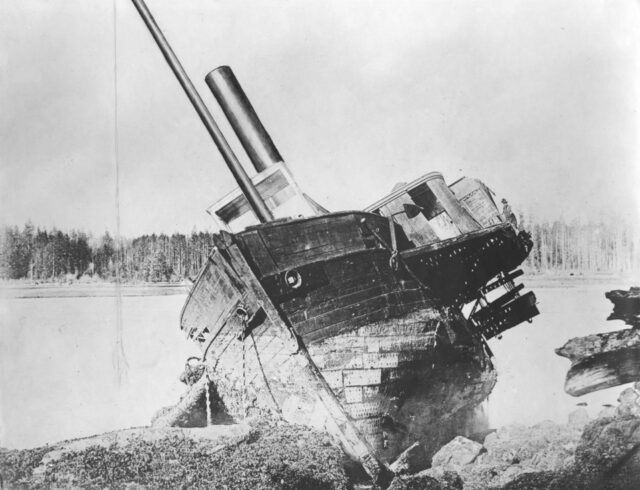
Whatever the cause, the ship sat on the rocks for the next four years and became a destination for souvenir hunters and a tourist attraction where people climbed on board and had their photos taken (if your ancestor was in one of these, I’d love to see it). In 1892, the wake from the passing SS Yosemite caused her to finally slip beneath the waves.
The Beaver was built in England in 1835 and spent over half a century plying the waters of British Columbia. She served as a floating trading post for the Hudson’s Bay Company, spent the 1860s and early 1870s in the service of the Royal Navy charting BC’s coast, and in 1874 she was sold to the BC Towing and Transportation Company where she worked until her death in 1888.
In 1951 a Province story headlined “Wreckage of SS Beaver still lies off city point” quotes Captain FW Pamphlet of North Vancouver. “There is a whole slab of the Beaver down there yet. I think we could bring her up with grappling irons,” he says. His father, Tom Pamphlet, once captained the ship.
I called Ashley Smith, curator of collections at the Vancouver Maritime Museum and asked her if there is anything left of the wreckage at Prospect Point. She says that there is and that divers still explore down there. “There’s quite a fair bit of the ship in museum collections including ours as well as in private collections,” she says. “Underwater archaeologists joke that you can make enough for three Beavers with all the pieces that everybody claims to have out there in the world.”
A salvage operation in 1962 recovered a boiler which lives at the front of the museum. Ashley says a side lever and engine parts are on display in the shipwreck gallery. The museum also has a large collection of photos that aren’t on display, but available to see by appointment.
Related:
© All rights reserved. Unless otherwise indicated, all blog content copyright Eve Lazarus.
If you love a shipwreck story like I do, check out Beneath Dark Waters: The Legacy of the Empress of Ireland Shipwreck


I’m skeptical of the “the crew was drunk” story. With a 4.8 m tide that squeezes between Propect Point and the entrance to the Capilano, “slack” is very short and timing is crucial. It was three days after a full moon, so anyone trying to transit would have still experienced spring tidal action with lower lows and higher highs. I suspect that was a large contributor.