


Last July, North Shore News reporter, Brent Richter sent me an email saying: “This one seems to have your name written all over it.” He included a link that sent me to an Instagram post showing a storage room full of three-sided cedar panels with colourful indigenous carvings. The post said: “Displaying a bit of North Shore history. We were told these were from the St. Alice, a North Shore landmark until its demolition in 1989. Can’t find any interior pictures of the Alice to confirm.”
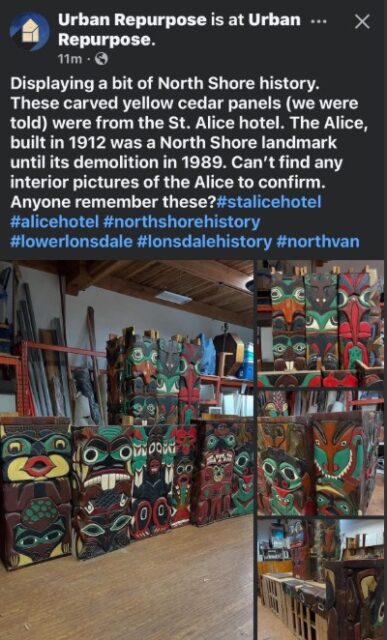
Quite honestly, I’d forgotten all about the post until I dropped into Urban Repurpose on Brooksbank Avenue just before Christmas.
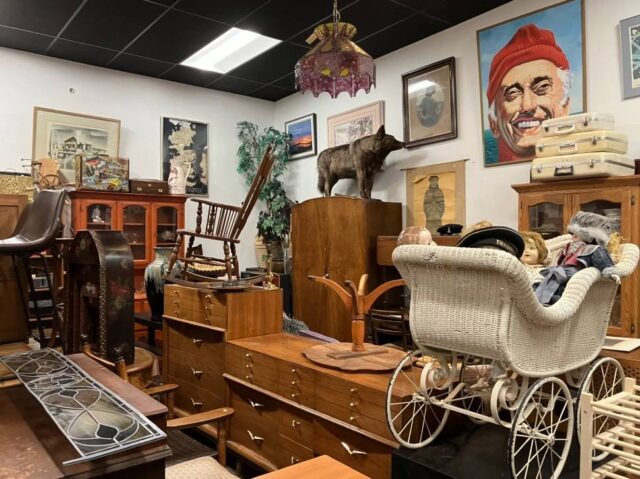
Urban Repurpose is a hoarders delight. It’s crammed full of household items, old furniture, construction material, books, music and art that at one point were destined for the dumpster. Tom Riessner is the founder of this magical place, and he has sorted these finds into different rooms. For instance, there’s a room for musical instruments and one for vintage items which has things like a taxidermied wolf, creepy dolls, sea-trunks, and a Keith Rice-Jones Tabernacle Box, ca.1998 for $1,195.
St. Alice Hotel:
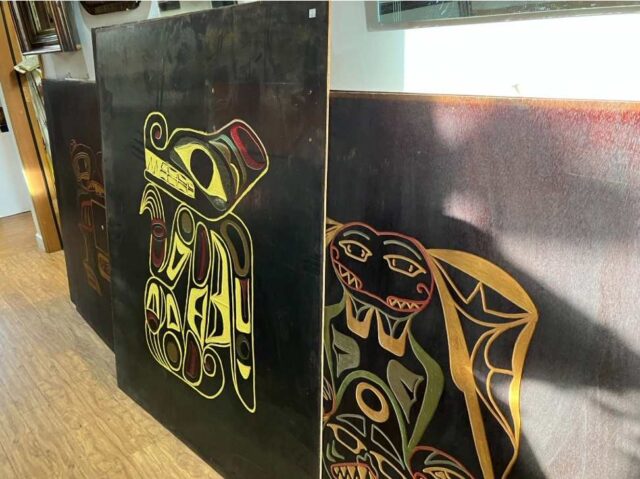
There were six large carvings on hardboard lining the wall of one of the passageways. Riessner says they are part of a collection of panels from the St. Alice Hotel. The cedar panels from the Instagram post had already been donated— three to the North Vancouver Museum and Archives (Monova) for a future exhibit, and the others were given to Dennis Joseph of the Squamish Nation to auction off for a fundraiser.
The St. Alice Hotel was a five-storey, brick 70-room hotel built in 1912 at West 2nd Street, near Lonsdale. In its early days it was considered quite swanky. By the ‘70s it was more of a sketchy beer parlour and SRO, and by the late ‘80s, it fell to the gentrification of the area. In its place is a 29-storey luxury high-rise named the Observatory where a three-bedroom condo recently listed for $3.75 million.
What I found really interesting was that the cedar panels and boards from the St. Alice were part of North Shore legend Phil Nuytten’s art collection. Most of us know him as a deep-sea diver and inventor, but he was also of Metis heritage, a master carver and a major collector of Indigenous art. He acquired the St. Alice panels just before the hotel was demolished in 1989. Nuytten died in 2023. In fact, he was restoring a totem pole at the time of his death.
Andrea Terron, curator at Monova, says the three panels that they currently have in storage are the same ones that can be seen in a 1970s photo. The photo was part of a collection donated to the archives earlier this year. The problem for the archives is that their origins are a bit of a mystery. One of the pieces has a signature that reads “Hopkins White Rock BC”.
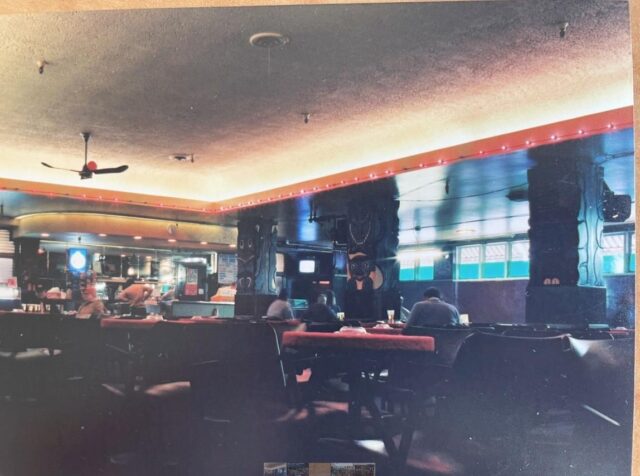
“We don’t know who made them, we don’t know anything. But it was important to save them,” she says. “They are just beautiful.”
I asked Terron if she thinks the panels had been commissioned by the hotel.
“That’s a great question and that’s one of the reasons why I wondered if we should take them or not,” she said. “It’s the question of provenance. if you don’t have the whole story, what do you do with the collection?”
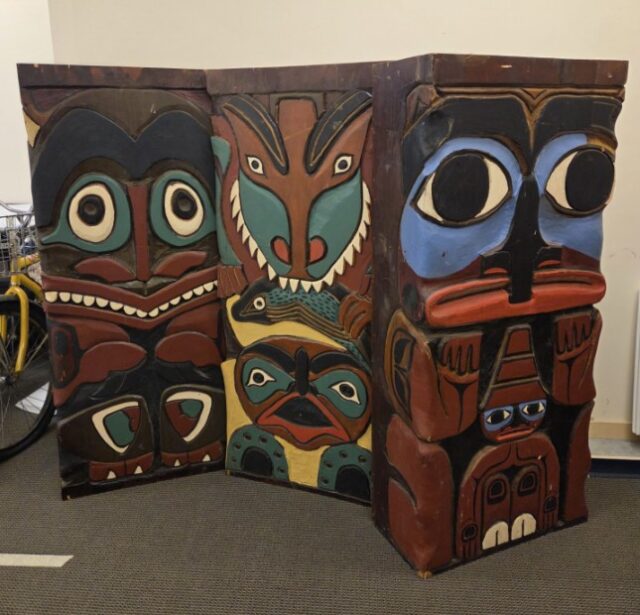
The panels are beautiful, full of bright greens and reds and yellows and blues. But Terron notes that they are not quite as polished as she would expect to see from an Indigenous master carver. She speculates that it could be someone who was learning to carve.
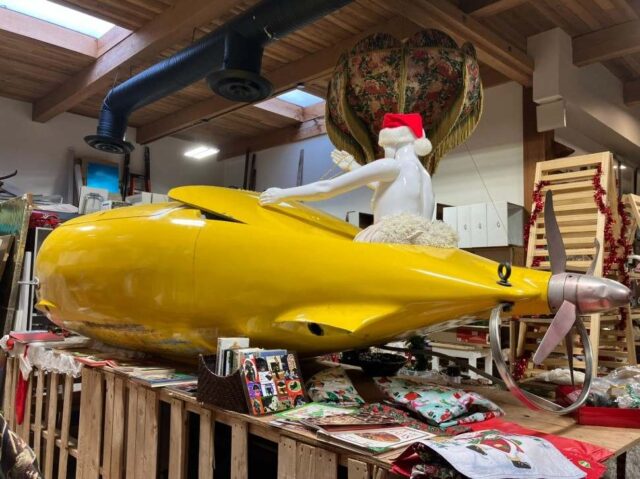
There were still half a dozen panels on hardboard left when I visited Urban Repurpose in late December and they were selling between $150 and $200 a panel. A small price to pay for a sliver of North Vancouver hotel history. But if that’s not quite your jam, there was the head of a harpoon from Hawaii and a 1950s mini yellow submarine selling for $5,500. Both are from Nuytten’s estate.
© All rights reserved. Unless otherwise indicated, all blog content copyright Eve Lazarus.


Regarding the Alice Hotel artwork. The Hopkins White Rock signed piece may be Pete Hopkins who lived in White Rock. He was a sign painter by trade and an artist. His signwork included the murals on the fence around several WhiteSpot restaurants, and the pirate scenes in the McDonalds restaurants. I have one of his paintings.
So interesting to see these. Thanks for writing about them. I’m a historian from Vancouver, now living in the UK. I wrote something about the St. Alice that might be of interest: https://globalurbanhistory.com/2016/12/08/neoliberalism-and-the-structure-of-settler-colonialism-in-a-north-american-city/
Best wishes,
John