


According to the handwritten board at Maplewood Flats, there were 32 different species of birds spotted in November. Sightings included Horned Grebes, Common Loons, Bald Eagles and Downy Woodpeckers.
Unfortunately, last Saturday’s torrential rain kept away all but three seagulls, one egret and a mob of angry mallards.
The Flats are a beautiful part of the coastline that comprise 126 hectares of land, just east of the Ironworkers Memorial Bridge. To put that into perspective, it’s about a third the size of Stanley Park.
History:
The mudflats provided a fishing ground for the Tsleil-Waututh Nation for thousands of years. From the 1920s, a sand and gravel company operated a quarry here. In the 1960s, the floors and buildings from demolished West End heritage houses were barged over, mixed with logs and garbage from the inlet and used as fill on the mudflats. Later that decade, a community of squatters—many of them artists and environmentalists—moved in and built shacks from salvaged materials above the tidal mudflats.
At least as far back as the 1940s, squatters were part of a long tradition of settlements such as Crabtown in North Burnaby and Finn Slough in Steveston. On the North Shore, the squatter community stretched from what’s now Cates Park to the Maplewood mudflats.

A Plan to Pave Paradise:
But the District of North Vancouver was determined to rid the land of squatters and replace their homes with a town shopping centre that would rival Park Royal. Two different developers, one with plans for a $100 million town centre and the other who wanted to add an apartment/commercial complex, faced off against the port and its plans for a container terminal with berths for six ships.
The first round of squatter evictions and burnings took place in 1971.
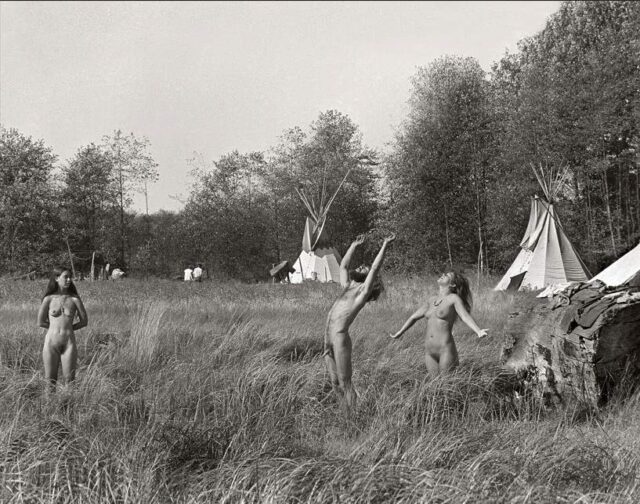
The following year, a group of mudflat residents put on the Dollarton Pleasure Faire, one of many held across North America in the 1960s and ‘70s. The two-week long counterculture Faire was a celebration of alternative living, an acknowledgement that its days were numbered, and it was timed to clash with the annual PNE held at the end of August. The Faire was also a show of support—the mudflat squatter community versus the District of North Vancouver.

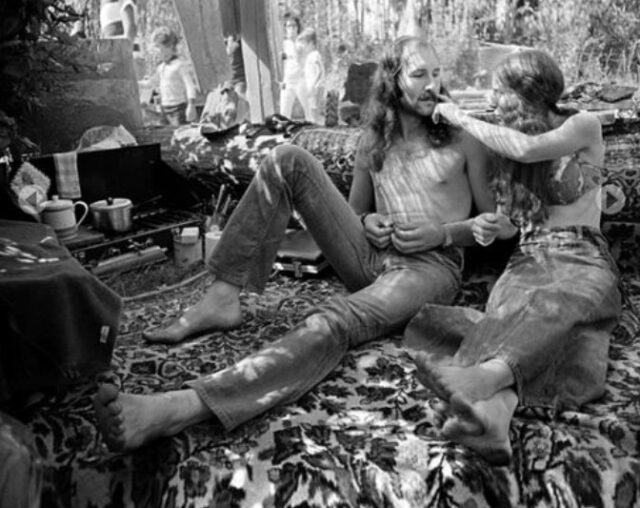
Fortunately, Bruce Stewart was there to document the Faire. He took several hundred photos using fast film, a wide-angle lens and a Nikon FTN.
He photographed an artist colony living in houses made from recycled materials—old pieces of boats and other debris that had washed up on the mudflats. There was the Pirate Ship house created from the abandoned hulk of a boat that was resting on a log. And there was the Glass House, an A-frame construction with assorted bric-a-brac and salvaged windows. He photographed the very young and the very old, naked and clothed who happily co-existed with those in their prime. You can see them dancing, swimming, making art and just hanging out in front of the incongruous backdrop of the Chevron oil refinery.

Off the Grid:
Says Stewart: “It was the end of an experiment in ‘off-the-grid’ living which was decades ahead of its time.”
The squatter village partially survived until 1973, when, except for one shack belonging to Mike Bozzer, the unofficial mayor of Maplewood, the remaining structures were destroyed. Bozzer managed to hang on to his home until 1981, when the district decided it didn’t meet public health standards and destroyed it as well.
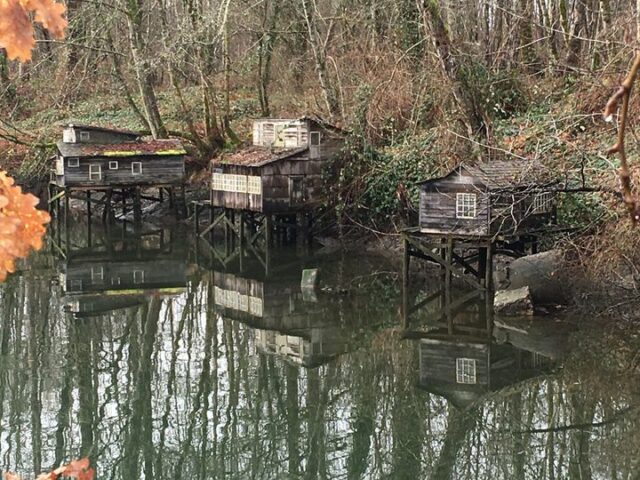
In the end, public outrage trumped development and today the Maplewood mudflats is a wildlife refuge. Aside from Stewart’s wonderful photos, the only evidence of the squatter community is artist Ken Lum’s miniature replicas of three of the cabins, placed on the slough near the car park. Lum created the shacks for the 2010 Winter Olympics. He modelled them after ones owned by artist Tom Burrows and Dr. Paul Spong, who later led Greenpeace’s Save the Whales Campaign. The third shack is a replica of author Malcolm Lowry’s shack that was on the trail in today’s Cates Park.
© All rights reserved. Unless otherwise indicated, all blog content copyright Eve Lazarus.


Thank you for describing another little-known (or long-forgotten) bit of our history, acknowledging and perhaps even celebrating the fact that nudity was common in counter-culture communities of that period.
Reminds me of “Poole’s Land” on The Island.
Privately owned land though…
It’s gone now. As is Michael Poole. Lost to the pandemonium and cancer.
https://www.vice.com/en/article/michael-poole-the-founder-of-pooles-land-a-psychedelic-commune-in-the-rainforest-dies/
Thank you for your good work, documenting North Shore history, Eve.
I do recall many great gatherings at the mudflats (1970s)! You may know that Malcolm Lowry had been a resident (was told that he also lived in the west end, in a building on Gilford / Comox near the Sylvia Hotel. I lived in that building 12 (1980s/90s) years, moved 3 times within it, and one of the apartments had been home to Mr Lowry.
Thanks so much Laura!
Thank you the article. Remember Malcolm Lowry stories well.
Its sad these places were lost to “progress”. I still would love to live at Fin Slough. Have since I was a kid living in Richmond.
I am looking for more information on the history between 1900s and 1960…more specifically about the sand and gravel company and the “In the 1960s, the floors and buildings from demolished West End heritage houses were barged over, mixed with logs and garbage from the inlet and used as fill on the mudflats”. If you can give me any advice for where I can find more, I would really appreciate your help.